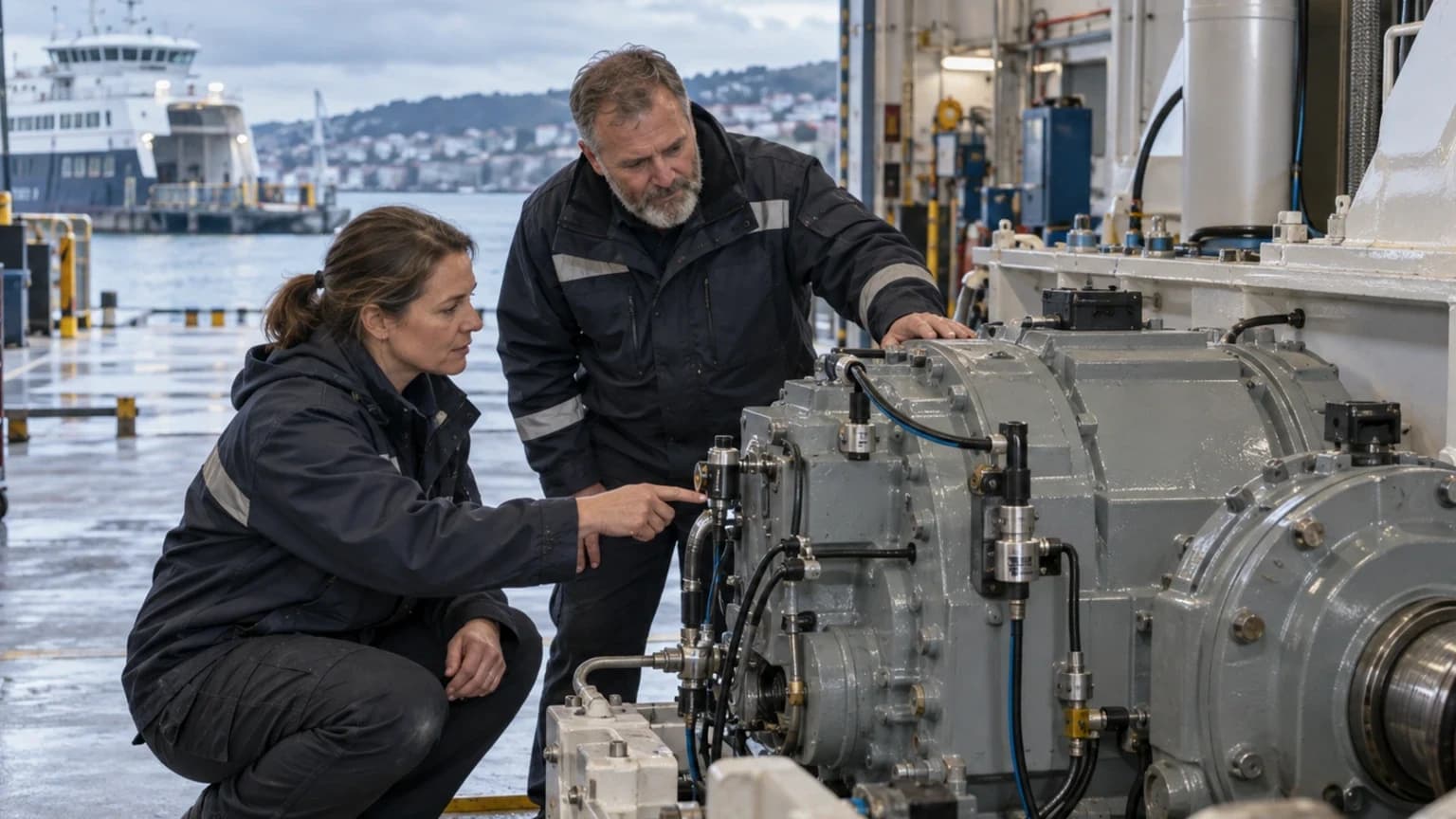
A gearbox demonstration can prove that data reaches shore; avoided cancellations require separate evidence.
This week's three marine technology announcements answer different buying questions. Evidence for one cannot support the others.
A signal still needs a maintenance decision
ZF's September 1 announcement describes a condition-monitoring proof of concept with Danish ferry operator Molslinjen. Gearbox electronics and sensors supply information including speed, pressure, temperature and operating modes; onboard hardware and mobile communication connect it to cloud analytics.
The intended operating chain is clear: sensor data reaches shore for condition-based maintenance. ZF supplies no quantified downtime reduction or predictive-accuracy result in this release. A buyer can examine the data path without treating the maintenance benefit as demonstrated.
A buyer should ask which finding changes a maintenance decision and how that change was tested. The release confirms visibility into the gearbox, but not the maintenance result.
A navigation pilot measures something else
For comparison, Orca AI's August 25 announcement is background from the previous week. The vendor reports that a five-vessel Eastern Pacific Shipping pilot covered more than 130,000 nautical miles, with close-encounter events per 1,000 nautical miles down 48 percent and average minimum passing distance up 10 percent. EPS plans deployment on dozens of additional vessels.
Those are reported navigation measures. They are more specific than a general promise of better operations, but they do not establish fewer collisions, lower maintenance costs or more available vessel-days. The announcement is vendor evidence, not an independent controlled evaluation, and the additional deployment is prospective.
Orca also describes a shore-side analytics product for reviewing events and supporting training. The vendor's account already includes an ashore decision process.
The boat builder has a price decision
This week's Wall Street Journal reporting on Brunswick describes the manufacturer's effort to support higher prices with upgrades as it seeks better margins. The commercial argument supplies no evidence that a fleet operator's costs fall by the amount the boat's price rises.
A feature can still be worth paying for when the operating improvement justifies its price. The buyer needs evidence of that improvement, separate from the manufacturer's margin ambition.
A buyer therefore has three questions: what maintenance action follows the sensor finding, how the navigation result was evaluated, and why an upgrade deserves its price.
Start the vendor meeting by asking who will make a different decision after installation and what evidence shows that decision improves the operation.